


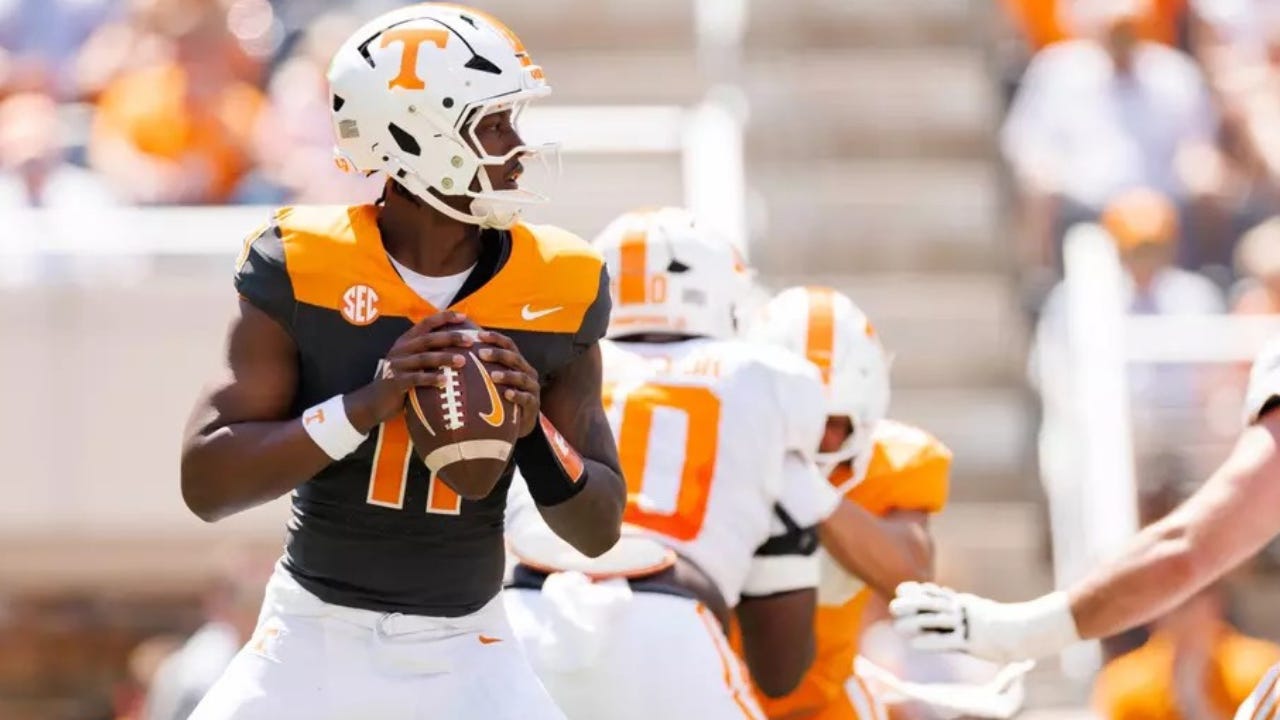
It’s the middle of May, and we do not know who will be under center against Furman to open the 2026 college football season for the Tennessee Volunteers. The same was true this time last year, too, after Nico Iamaleava’s sudden spring departure and Joey Aguilar’s late-spring arrival. In a perfect football world, you would prefer to know who will be your team’s starting quarterback sooner rather than later. However, as you saw with Tennessee’s offense last season, particularly out of the gate, the musical chairs at quarterback turned out to be a nothing burger for the Vols. Perhaps once the George MacIntyre vs. Faizon Brandon quarterback battle is settled, I’ll look back this time next year and write something similar. Sticking with this upcoming season, though, I do wonder how much I will end up writing about the quarterback play this fall for the Tennessee Volunteers.

If you’re a glass-half-full person, the offensive line is where you look first to make the case that the quarterback play of either MacIntyre or Brandon will be just fine this upcoming season. You feel good about David Sanders going into his first full season as Tennessee’s left tackle, and the hit-rate for blue-chippers at this premium position of late. Tennessee also returns Sam Pendleton, their starting center last season. They return Wendell Moe Jr., their starting left guard last season. They return Jesse Perry, their starting right tackle and, at times, right guard last season, and they return Sham Umarov, who started 10 games at left guard for the Vols last season. Outside of the departure of last year’s starting left tackle, Lance Heard, who transferred to Kentucky this offseason, the Vols are bringing a whole lot of production and snaps back to protect MacIntyre or Brandon this season.
The difference in playmakers out wide and at tight end will also be vastly different for MacIntyre or Brandon than it was for Iamaleava as a redshirt freshman in 2024, not to mention the offensive scheme changes. One of the most fascinating developments will be Tennessee’s projected top-two tight ends, Ethan Davis and DaSaahn Brame, and how big a role they play in the passing game as a reliable safety valve for Tennessee’s quarterback. Under Josh Heupel, the Vols have not had this much receiving upside at tight end. We saw in the NFL Draft this year, and with the Los Angeles Rams last year, that 13 personnel is all the rage in 2026, so it’s fair to wonder how much Heupel and his staff utilize the two extremely talented playmakers this fall. If you’re MacIntyre or Brandon, you have to be excited about the playmaking potential of Tennessee’s top two tight ends before even getting into the wide receiver spot.
Speaking of the wideouts, Tennessee’s two breakout wideouts, Braylon Staley and Mike Matthews, are back. Now, who takes Chris Brazzell II’s place as the third starter will be interesting to see play out over the next few months. It could be Radarious Jackson, Travis Smith Jr., or Tristen Keys. Whatever combination wide receivers coach Kelsey Pope elects to roll with this fall, the Vols will have former four or five-star options in every combination he uses until he finds his best three. It’s another great development for a young quarterback to walk into.
Tennessee might even have an award-winner at tailback in DeSean Bishop. The former Karns star was a Second-Team All-SEC player for Tennessee last year. He rushed for over 1,000 yards to keep that Volunteer running back streak alive. He averaged nearly six yards per carry in his first full season as the Vols’ lead tailback. Bishop might not be as explosive as former Tennessee star Dylan Sampson, but he could be just as valuable. Like Sampson significantly helped Iamaleava in 2024, Bishop should provide similar consistency and stability to help MacIntyre or Brandon.
I suspect the defense, particularly the front seven, will be the dominant talking point this fall, not the quarterback once a starter is named for the latter. There are too many positive and safe indicators around them not to expect the offense to be just fine for the majority of the season.
With the change at defensive coordinator from Tim Banks to Jim Knowles, the latter a championship-winning coach who completely stifled Tennessee’s offense in the first round of the 2024-25 College Football Playoff in Columbus, and a young quarterback under center, the Vols need the defense to be a whole lot better than it was in 2025 because the offense isn’t likely to be better, or as explosive vertically, as it was in 2025.
There is uncertainty at LEO. Former blue-chippers Caleb Herring and Jordan Ross transferred to rival SEC programs. Joshua Josephs was drafted in the fifth round by the Washington Commanders. Chaz Coleman, Tennessee’s big splash at LEO out of Penn State, is the biggest unknown on the defense. If he’s not a factor, and Tennessee’s pass-rush is non-existent in conference play, that’ll matter a whole lot more than who is under center for the Vols.
At linebacker, Tennessee has lots of talent, but lots of unproven talent behind Arion Carter and Amare Campbell. If the spring transfer portal window were still a thing, I do wonder how much movement there would have been at this position and at LEO. The Vols have more than enough capable bodies at linebacker, but might not have nearly enough off the edge. You can never have enough pass-rushers off the edge, but we will find out this fall if you can have too many linebackers. Just how realistic is it for linebackers coach William Inge to be able to rotate so many talented blue-chippers with two veteran leaders like Carter and Campbell at the top? It’s a good problem to have in mid-May, but that might not be the case in mid-October if the Vols’ defense can’t get off the field on third down because the pass rush can’t get home consistently.
In the secondary, Tennessee could have its best overall unit to this point in the Heupel era in Knoxville. You feel pretty set there, particularly with how productive and how experienced the vast majority of the transfer portal additions they made in this position room are. Tennessee really needs Daevin Hobbs to get healthy and stay healthy along the defensive interior. They need Coleman to be a factor off the edge. They need Ethan Utley and Isaiah Campbell to take a step. They need Marion Dye and Tyree Weathersby to be anchors at defensive end. I’m not in the business of doubting Tennessee defensive line coach Rodney Garner, but how the defensive line performs figures to be a much larger season-long talking point than how the quarterback performs. The floor of Garner and new LEO coach Andrew Jackson’s defensive line is uncharacteristically uncertain. Football is a team game, and the Vols averaged 1.80 sacks per game in their five losses last season and 3.5 sacks per game in their wins.
Yes, quarterback is the most important position in the game, but as everything stands right now for Tennessee, the best bet for the biggest talking point all year for the Vols will not be MacIntyre or Brandon – it will be Tennessee’s defensive line, as their productivity will be the biggest needle-mover in wins and losses all season long.